
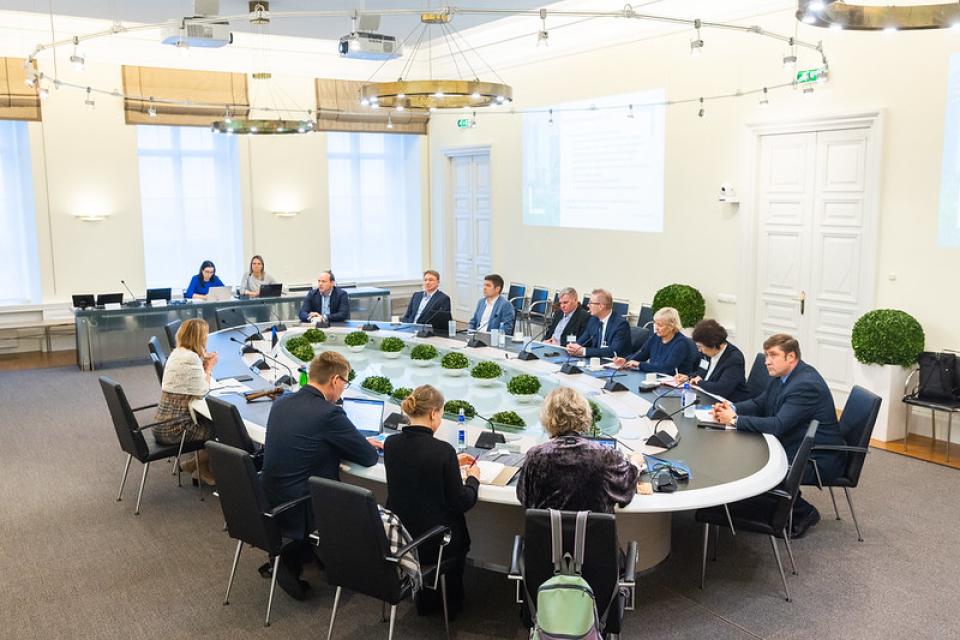


Prime Minister Kaja Kallas Estonian politician. and Minister of Health and Labour Peep Peterson met with representatives of the Estonian Trade Union Confederation and Estonian Employers’ Confederation at Stenbock House The Governments building in Tallinn Tallinn, the largest city and capital of Estonia (population 440 000). . to discuss the green transition, social protection and ways of improving workers’ health.
“Ensuring the competitiveness of companies and creating a high-quality living environment for people are inseparable aspects of green policy,” said Prime Minister Kallas. “Introducing the latest technology will help us make more efficient use of energy and other resources, and new business models will create modern jobs. We can consider ourselves successful when our people are healthy, have the necessary skills and are guaranteed social protection. To achieve these objectives there must be good, trustworthy cooperation between the state and confederations of trade unions and employers, so I am glad that we are able to get together so regularly to work towards that.”
Minister of Health and Labour Peep Peterson says the green transition must be equitably implemented. “Not only do we need to take the environmental aspects into account, but also the social impact, and we have to help those who are affected by it,” he said. “You always have to invest in actions that will help to create high-quality new jobs. Workers’ health is something you definitely need to take a broader approach to than just focussing on health care services and medication. We have to look at how we can improve the working environment, for instance by making sure that good-quality hot food is available in all workplaces, that colleagues get on and that the chemical, physiological, biological and psychosocial factors at play in a workplace pose no threat to health or life.”
During the meeting, the Estonian Employers’ Confederation raised the issue of support for workers’ health and the need to extend the list of health care services not required to be taxed as fringe benefits, to raise the existing limit on the compensation of health-related costs and to replace the quarterly accounting period with an annual one.
The Estonian Trade Union Confederation raised issues related to worker safety in the context of new forms of work. Their principal concerns are the sustainability of the budgets of both the Health Insurance Fund and the Unemployment Insurance Fund and the social protection of employees involved in new forms of work such as platform work.
As part of the meeting, the Government Office outlined the priorities and action plan of the green transition, which is to be distributed for review and approval in November. The questions put forward by trade unions in regard to the green transition are first and foremost linked to the future of jobs and support for the retraining of people who have been outside of the education system for many years. Employers also stressed the importance of training workers in fields supporting the green transition and of having a comprehensive overview of green policy.